
By MV International | 24 August 2026
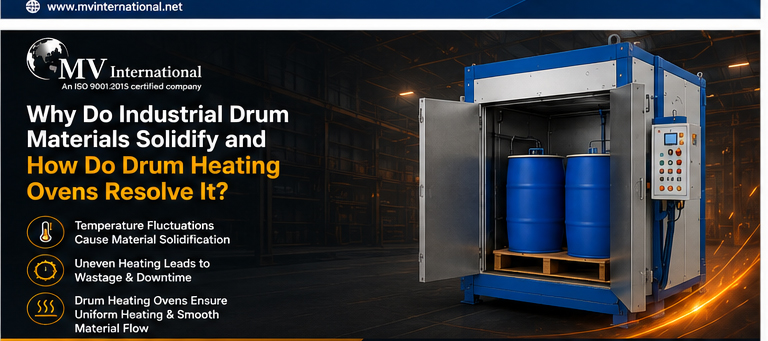
Industrial drum materials solidify and refuse to pour when low ambient temperatures exponentially increase their viscosity, causing substances like polyurethane resin, bitumen, and synthetic waxes to congeal. A drum heating oven resolves this by applying controlled, uniform thermal energy to lower the material’s viscosity, restoring optimal flow characteristics for efficient pumping, extraction, and downstream processing without causing thermal degradation.
Standard industrial drum heating ovens achieve operational temperatures up to 400°C. However, operators process most highly viscous materials, including epoxies, heavy lubricating oils, and industrial adhesives, at significantly lower, thermostatically controlled temperatures. This precision heating lowers viscosity while preventing the chemical composition from altering or burning.
Thermal processing cycles typically range from 30 minutes to 8 hours. The exact duration depends on the 200-litre drum volume, the specific heat capacity of the contents, the target pumping viscosity, and the overall heat transfer efficiency of the oven chamber.
Selecting the correct heating media optimizes operational efficiency and aligns with existing facility infrastructure:
| Heating Media | Infrastructure Requirement | Primary Industrial Application |
| Electric | 3-Phase power supply | Small batches, laboratories, and precise cleanroom environments requiring digital PID temperature control. |
| Gas-Fired | Industrial gas line | High-volume production demands rapid heat-up times and lower utility costs. |
| Steam / Thermic Fluid | Existing boiler systems | Continuous manufacturing facilities seeking the most cost-effective thermal transfer for massive scale. |
Yes. Manufacturers engineer drum heating ovens for highly scalable batch processing. Structural fabrication accommodates configurations ranging from a single-drum laboratory unit up to heavy-duty 32-drum systems designed for high-capacity petrochemical and industrial throughput.
Standard industrial heating systems pose ignition risks for volatile substances. Processing petroleum products, chemical solvents, or highly flammable resins requires a flameproof drum heating oven. These specialized units are rated for Zone 1 and Zone 2 hazardous areas, integrating explosion-proof heating elements, sealed motors, and robust construction to prevent internal sparks from igniting volatile gas vapors.
Drum melters are engineered to process temperature-sensitive and highly viscous substances across manufacturing sectors:
Inadequate thermal distribution generates localized hot spots within the heating chamber, resulting in product scorching, thermal degradation, and ruined material batches. A professionally engineered drum heating oven relies on forced air circulation via motorized industrial blowers to guarantee uniform heat distribution across the surface area of every drum.
Equipment sizing relies on daily production throughput, heating cycle times, and available floor space:
| Oven Capacity | Manufacturing Scale | Typical Use Case |
| 1–2 Drums | Laboratory / R&D | Small-batch formulation, prototype testing, and research. |
| 4–8 Drums | Mid-Scale | Continuous processing lines require steady material flow. |
| 12–16 Drums | High-Volume | Commercial manufacturing and heavy industrial output. |
| 24–32 Drums | Massive-Scale | Large petrochemical refineries and bulk storage facilities. |
MV International has engineered and manufactured standard and flameproof drum heating ovens since 1989. Operating as an ISO 9001:2008 certified manufacturer serving over 1,800 clients across 50 countries, the company custom-designs thermal solutions matched to exact material viscosity requirements, hazardous area safety zones, and batch production volumes.
Get a free technical estimate:
Phone: +91 9718290000 / +91 9810245368
Email: mverma@mvinternational.com
Website: mvinternational.com
Copyright © 2026 MV International. All Rights Reserved.