By abdul | 5 October 2026
Welding electrodes look tough, but they are fussy about moisture. Leave a box of low hydrogen rods open in a damp workshop overnight and the flux coating quietly pulls water out of the air. You will not see it happen. You will see it later as porosity, cracking and a weld that fails inspection. That is why fabrication shops keep a drying oven running next to the welding bay, and why buyers compare oven electrode manufacturers carefully before they place an order.
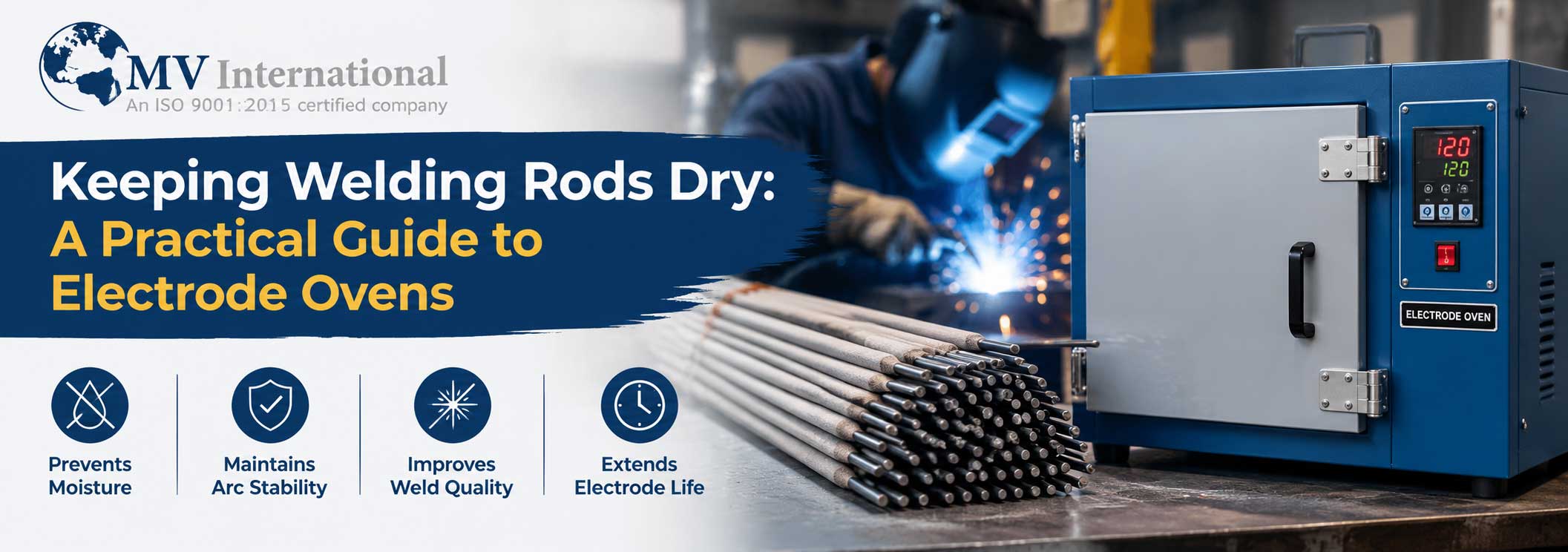
The job is simple to describe. The oven holds rods at a steady temperature so the coating stays dry from the moment the packet is opened until the rod is struck.
There are three common jobs on a site:
Most plants need more than one of these. A big stationary unit does the baking, a portable quiver goes out with the welder, and a flux oven handles submerged arc work. Good Oven Electrode Suppliers will ask which of the three you need before quoting anything.
Because hydrogen is the enemy. Moisture in the flux breaks down in the arc and releases hydrogen, which gets trapped in the weld metal as it cools. In thick sections and high strength steels, this causes cold cracking, sometimes hours after the weld looks finished.
Electrode makers print drying instructions on the packet for exactly this reason. A typical low hydrogen rod is baked at a few hundred degrees for one or two hours, then held at a much lower temperature until it is used. The oven is simply the tool that lets you follow those instructions properly.
MV International has been building this kind of equipment since 1989 and now serves customers in over fifty countries, which is why many buyers looking for reliable Oven Electrode Exporters start their search here.
This is the question that comes up most often, and the answer is about scale.
Portable electrode ovens
Stationary mother ovens
MV International builds both, along with top loading and front loading SAW flux baking ovens, flux holding ovens and mother flux ovens. Buyers who want everything from one place tend to prefer Oven Electrode Manufacturers who cover the full range rather than a single product.
Work backwards from your daily consumption, not from the cheapest unit on the list.
Ask yourself:
A unit that is slightly larger than today’s need is usually the better buy. Shops grow, orders get bigger, and an oven that is always full never gets a chance to recover its temperature between loads. Experienced Oven Electrode Suppliers will happily size a unit against your actual shift figures instead of pushing a standard model.
Not every option earns its place, but these usually do:
Yes, and it regularly is. MV International is an ISO certified maker based at Bahadurgarh in Haryana, supplying the Gulf, Europe, Africa, South East Asia and beyond. Machines are built for the destination voltage and frequency, packed for sea or air freight, and supported with drawings before dispatch. That track record is what separates genuine Oven Electrode Exporters from traders who simply forward an enquiry to someone else.
Dry rods mean sound welds. An oven is a small investment next to the cost of repairing a cracked joint or losing a client’s approval. Work out your daily load, match the oven to it, and buy from a maker who builds the equipment in house and stands behind it afterwards.
To discuss sizes, temperatures or a custom build, contact MV International on +91 9718290000 or email mverma@mvinternational.com.
Copyright © 2026 MV International. All Rights Reserved.