By MV International | 26 August 2026
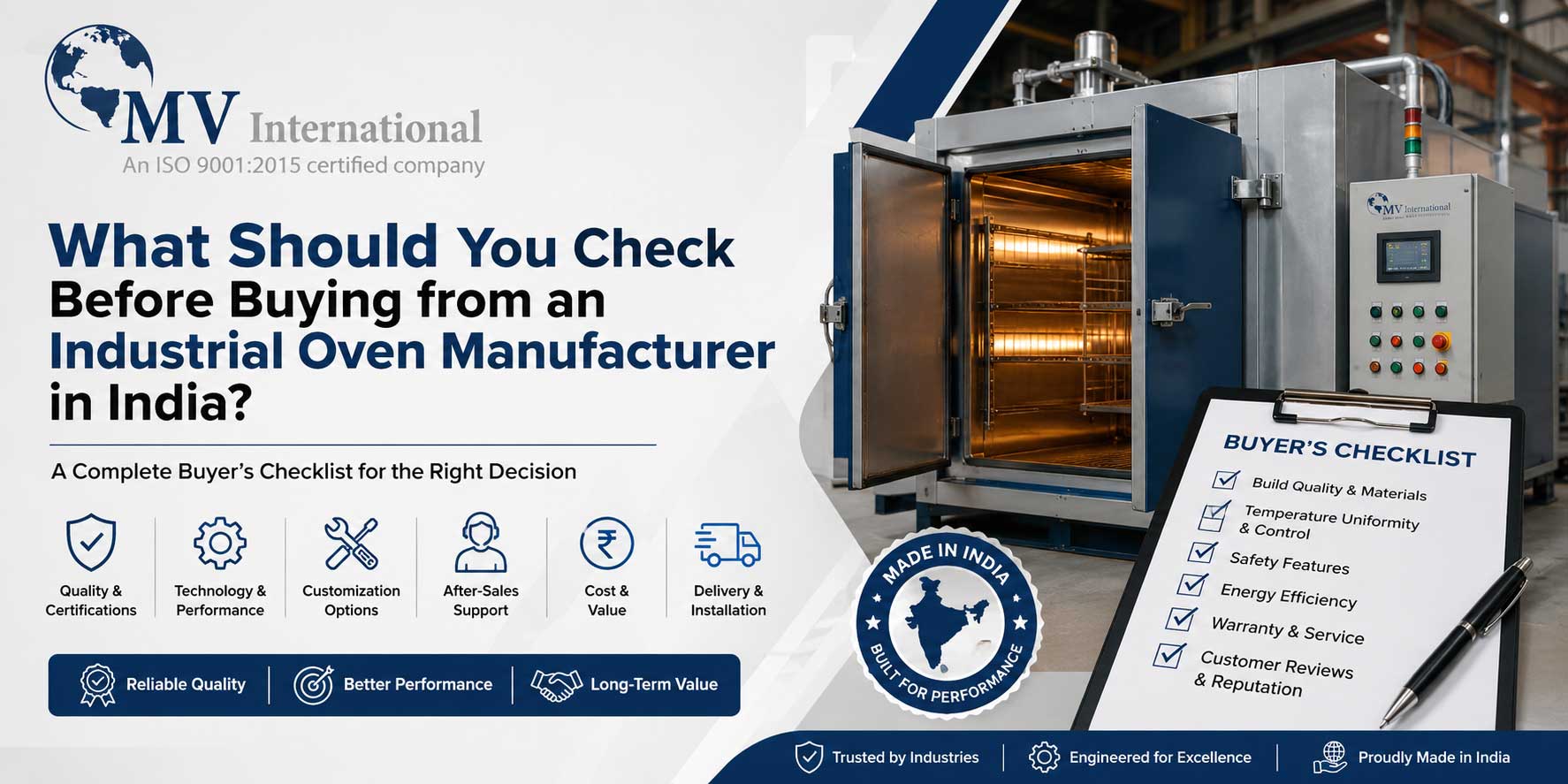
Before buying from an industrial oven manufacturer in India, verify their factory location, confirm ISO 9001 certification, assess custom engineering capabilities for specific thermal processes, ensure they provide direct after-sales support, and review their export track record. This evaluation separates authentic manufacturers from third-party traders.
Evaluate technical expertise and infrastructure to distinguish manufacturers from traders:
MV International has manufactured industrial ovens from its ISO 9001:2008 certified facility in Bahadurgarh, Haryana, since 1989.
Buyers in Delhi NCR, Haryana, and Punjab are in proximity to major industrial manufacturing hubs like Bahadurgarh and Faridabad. However, geographic proximity should not override technical capability. Manufacturers that execute pan-India installations and international exports adhere to stricter safety standards, secure packaging protocols, and reliable thermal performance benchmarks compared to strictly local suppliers.
Full-scale manufacturers design heating solutions for diverse industrial applications, including aerospace, automotive, electronics, and pharmaceuticals:
| Oven Category | Core Industrial Applications |
| Industrial Batch Ovens | Small-batch curing, moisture drying, Teflon coating, composite curing |
| Industrial Drying Ovens | Moisture removal, electric motor stator drying, component aging |
| Industrial Heating Ovens | Preheating dies, heat treatment, annealing, stress relieving |
| Industrial Conveyorised Ovens | High-volume continuous production lines, automated thermal processing |
| Powder Coating Ovens | Paint booths, continuous powder curing, automated spray systems |
| Welding Ovens | Electrode and flux drying, holding, moisture prevention |
Selecting the correct heating media impacts operational efficiency and energy consumption:
Industrial oven pricing relies on engineering specifications rather than flat rates. Key cost drivers include:
Export capability indicates compliance with international manufacturing and safety standards. Established manufacturers manage specialized export packaging, international voltage adaptations, and customs documentation. MV International exports industrial heating equipment to over 50 countries across the Americas, Europe, Africa, and Asia.
| Reliable Manufacturer | Red Flag |
| Own factory with a verifiable address | Vague or hidden facility location |
| ISO and CE certifications | Lacks documented quality control |
| Custom specs (PID controllers, variable heating media) | Only offers fixed catalog sizes |
| Direct installation and AMC support | Support terminates after delivery |
| Documented international export track record | No international client references |
Provide your chamber dimensions, maximum operating temperature, preferred heating media, and batch capacity to receive an accurate technical proposal. MV International leverages 30+ years of experience, 144+ employees, and 45+ in-house experts to deliver precision industrial ovens.
Get a free technical estimate:
Call: +91 9718290000 / +91 9810245368
Email: mverma@mvinternational.com
Website: mvinternational.com
Copyright © 2026 MV International. All Rights Reserved.