
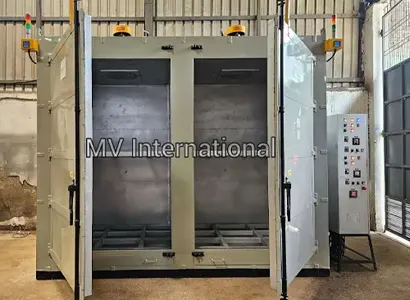
By MV International | 24 March 2026
Processing thick industrial fluids requires strict temperature management to maintain material integrity. When viscous substances like resin, honey, or heavy oils drop in temperature, they solidify and halt production lines immediately. The primary challenge involves raising the temperature of these bulk materials safely without scorching the edges or leaving cold spots in the centre. We need to examine the mechanics of thermal distribution in a drum heating oven and understand why relying on basic surface elements often fails. A structured approach to thermal processing solves these common industrial bottlenecks effectively.
Heating bulk containers involves complex physics compared to simply applying electrical power to the exterior steel. If the outer layer of the liquid gets too hot, it degrades chemically, ruining the entire batch. Poor thermal management causes the active ingredients to separate, which renders the raw material useless for downstream manufacturing. By utilising a dedicated drum heating oven, facility managers guarantee that every drop of the product reaches the target operating temperature simultaneously. This precise control prevents the massive financial losses associated with ruined raw materials and discarded batches.
Industrial equipment must distribute thermal energy intelligently throughout the internal space. Engineers achieve this by circulating hot air rapidly around the entire vessel rather than relying on direct surface contact. Our technical specialists at MV International design equipment that focuses heavily on this forced convection principle. Moving the hot air vigorously prevents dead zones where cold drafts typically settle near the floorboards.
| Heating Method | Heat Transfer Type | Risk of Material Scorching | Energy Efficiency |
|---|---|---|---|
| Silicone Band Heaters | Direct conduction | High at contact points | Moderate |
| Steam Jackets | Indirect convection | Low overall risk | High depending on boiler |
| Enclosed Thermal Chamber | Forced air convection | Extremely low risk | Very high continuous efficiency |
Your daily operational volume dictates the type of machinery necessary for your facility. Storing multiple containers outdoors in winter demands a different approach compared to processing single batches in a temperature-controlled laboratory. You must evaluate the base chemical properties of your materials before acquiring new machinery. Highly sensitive polymers require slow ramp-up times, while standard lubricants tolerate rapid thermal increases. Incorporating a programmable drum heating oven ensures you can adjust the digital parameters to match the unique physical properties of different materials.
Evaluating your current production bottlenecks reveals where thermal inefficiencies cost your business money. Reviewing the engineered solutions developed by MV International offers a practical baseline for upgrading your material handling infrastructure. Proper equipment selection safeguards your raw materials and keeps your production schedules running smoothly.
How long does it take to melt a solid block of resin?
The timeframe depends on the starting ambient temperature and the specific gravity of the material. Most systems, including a standard Drum heating oven, require several hours of gentle thermal application to safely reduce viscosity without damaging the product.
Do these chambers accommodate different vessel sizes?
Standard chambers hold various container sizes, from small five-gallon pails to large intermediate bulk containers. Adjustable shelving and heavy-duty floor guides help operators position different loads safely for uniform exposure. The internal framing supports substantial weight limits, ensuring the equipment remains stable even when fully loaded with dense liquids. This structural versatility allows factories to process multiple packaging formats using a single heating appliance.
Are these units safe for hazardous factory zones?
Equipment designed for volatile environments includes explosion-proof fittings and specialised ventilation systems. You must specify your facility’s safety rating when discussing new installations with MV International to ensure total compliance.
Copyright © 2026 MV International. All Rights Reserved.