By MV International | 7 September 2026
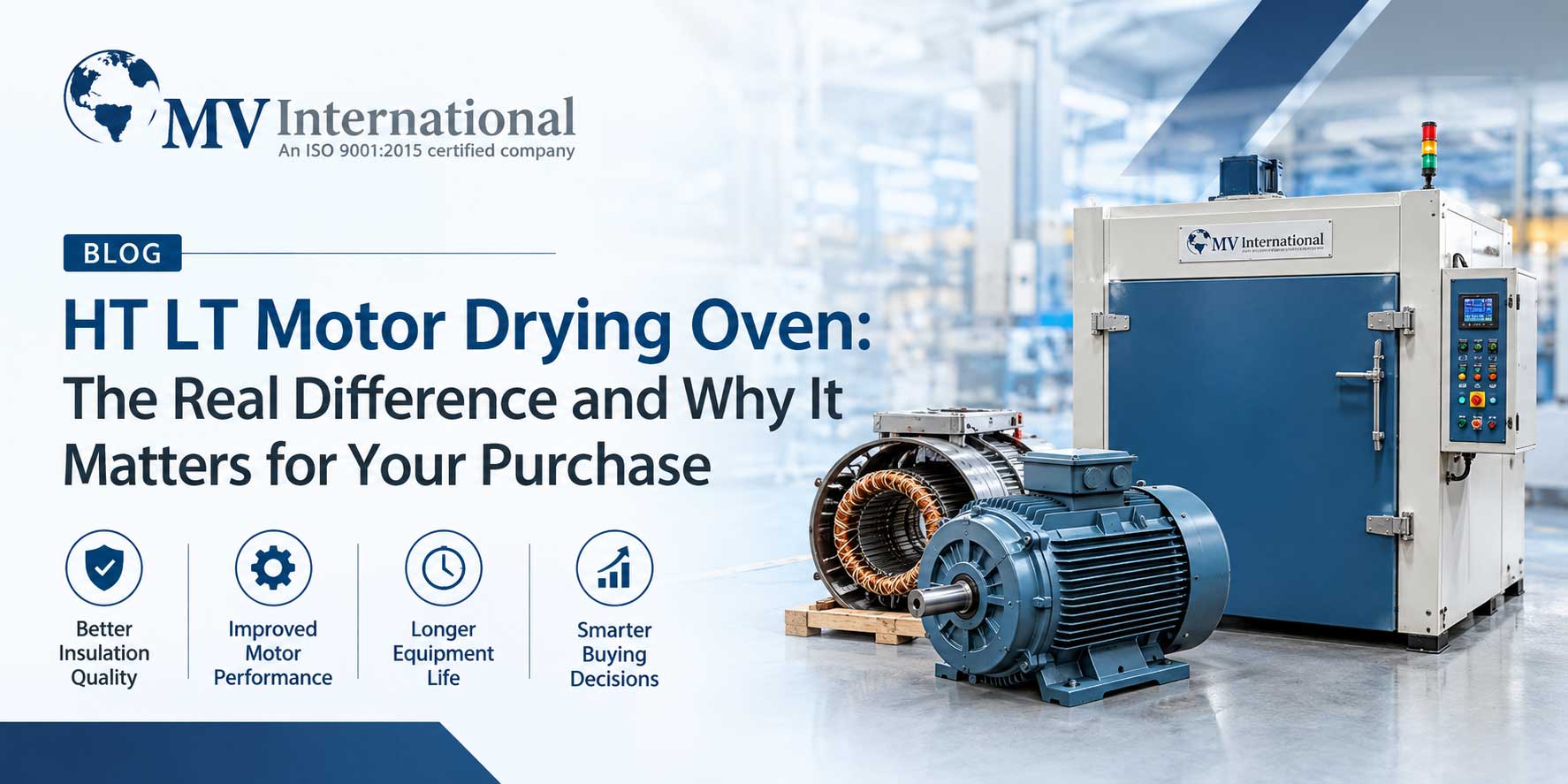
“Do I need a high tension oven, or will a low tension one do the job?” It is one of the most common questions repair shops and motor manufacturers ask before buying new equipment. Sadly, most product pages never actually take the time to answer it. Choosing the right electric oven for HT and LT motors is a vital decision for your workflow. Pick the wrong equipment, and you risk insulation breakdown, costly delays, and severe operational bottlenecks on the shop floor.
The primary difference comes down to electrical stress. High Tension (HT) motors carry significantly higher voltage stress on their insulation compared to Low Tension (LT) motors. Because of this extreme stress, HT motors have absolutely no tolerance for residual moisture. Even microscopically small drops in insulation resistance can trigger a complete system failure.
Therefore, the oven curing an HT motor needs much tighter temperature parameters and flawless airflow control. It is not just about buying an oven with a larger internal chamber. You are paying for a much higher level of environmental precision.
The short answer is yes. You can absolutely use the exact same oven for both HT and LT motors, provided the equipment offers a wide, highly precise temperature range. Reliable, uniform airflow control is also mandatory here.
The physical shell of the equipment matters a bit less than the accuracy of its internal sensors and controls. If your oven can hit the strict tolerances required for HT grade motors, it can easily handle your standard LT jobs. As a bonus, many facilities also use these exact units as varnish curing ovens, which improves physical properties like the tensile and flexural strength of the motor.
Insulation resistance drops because high tension motors operate under massive, constant electrical stress. Under those extreme conditions, even a tiny amount of trapped moisture creates a huge operational risk.
Insulation breakdown rarely happens overnight. It usually starts with residual moisture that was never fully removed during the initial curing process. Highly precise oven heating ensures that every bit of moisture is completely baked out before the motor ever goes back into service.
A standard curing cycle takes anywhere from 8 to 12 hours. However, this timeframe is not a strict rule. The exact timing depends heavily on the total winding mass, the initial moisture content of the motor, and the specific curing temperature required by the resin or varnish you are applying.
For motor curing applications specifically, electric heating is almost always the better choice. Electric systems offer much more precise temperature control compared to older gas fired units. They also require lower routine maintenance and provide a completely clean operation. This means you do not have to worry about combustion byproducts contaminating the sensitive motor windings during a long cycle.
Correct sizing comes down to a few core factors. First, consider your average daily batch size and how many motors you actually need to process per cycle. Next, look at your largest anticipated motor dimensions and the maximum weight your racks can hold.
You also need to verify the required temperature range and ensure the airflow design can reach all tucked away parts of the winding. Get these calculations wrong, and you will either pay for heating capacity you never use, or you will constantly bottleneck your repair schedule waiting for the oven to free up.
For HT and LT motor ovens, advanced safety features are the baseline, not a luxury. You should expect heavily insulated panels to limit external heat exposure and protect your floor workers. Door interlocks that prevent accidental opening mid-cycle are crucial.
The oven must also have automatic shutdown alarms in case of a thermal fault, along with controlled, uniform airflow to prevent dangerous hot spots. If a supplier tries to sell these basic protections as optional upgrades, you should probably look for a different manufacturer.
Pricing depends entirely on the chamber size, the total power rating, and the level of control automation you select. Low volume repair shops often manage fine with simple manual controls. Conversely, production scale rewinding facilities usually justify the higher cost of semi-automatic controls for better consistency.
Most standard shop units run in the 6 to 9 kilowatt range. Rather than just comparing sticker prices online, you should share your specific motor sizes and daily batch volumes with a manufacturer to get an accurate, custom quote.
An electric oven sits right at the critical point between winding completion and final testing. If this step fails, your entire repair schedule grinds to a halt.
MV International has manufactured these heavy-duty industrial ovens since 1989. Holding ISO 9001:2008 certification, they currently support over 1800 clients across 50 countries. Their equipment sizing is built around real world repair timelines rather than idealized laboratory conditions.
Get a free estimate today. Call +91 9718290000 or +91 9810245368, email mverma@mvinternational.com, or visit mvinternational.com.
Copyright © 2026 MV International. All Rights Reserved.