By MV International | 17 July 2026
Running a manufacturing plant is demanding work. Between managing supply chains and hitting production quotas, the last thing you want is a thermal processing bottleneck eating into your profit margins. Whether you are curing coatings, drying parts, or annealing metals, your heating equipment is the core of your production line.
As a trusted manufacturer at MV International, we spend a lot of time talking with plant engineers and facility managers. Almost daily, we hear the same pressing question. Which is the better investment, batch ovens or a continuous oven?
Honestly, there is no magic answer that applies to everyone. Both systems use proven thermodynamic principles to get the job done. The real difference lies in how they handle your specific workflow, floor space, and production volume. Let us break down the realities of both options so you can make the smartest, most profitable choice for your factory floor.
To make sense of the choice, it helps to look at exactly how products move through the heating cycle.
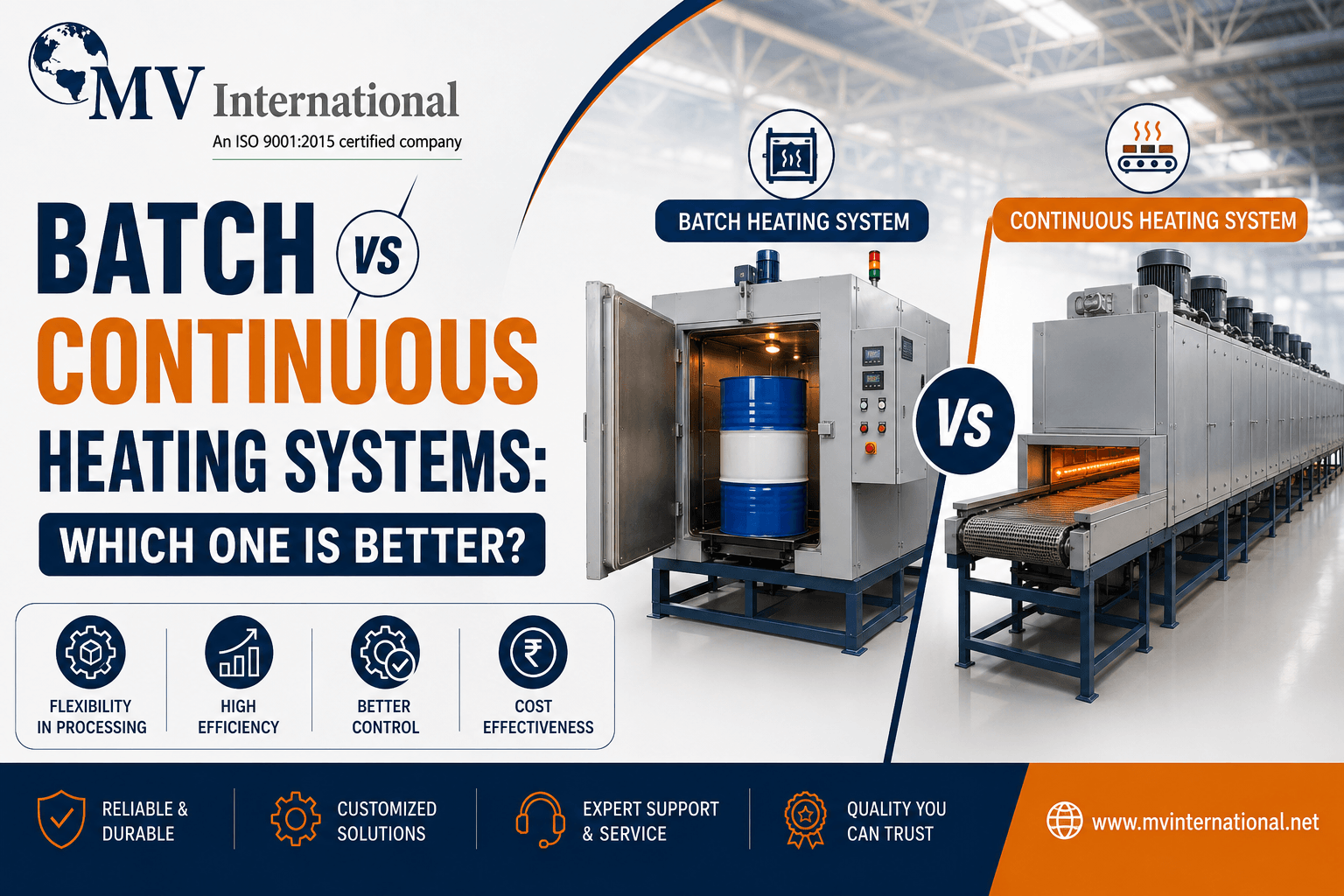
A batch oven processes materials in isolated, separate loads. Operators place the parts onto racks, load them into a sealed chamber, and start the cycle. The oven heats up to the target temperature, holds that heat for a specific dwell time, and then cools down before the parts are removed. You are essentially starting from scratch with every single load.
A continuous oven, which many people call a conveyorized oven, is built for a relentless, uninterrupted flow of materials. Products sit on a moving belt or roller system that carries them smoothly through dedicated thermal zones. You typically have a preheating zone, a soaking zone, and a cooling zone. Because the main chamber stays at the target operating temperature constantly, you never waste time or energy reheating the walls from room temperature.
Do not let the manual loading fool you. Batch ovens are the absolute workhorses of the manufacturing world. For many facilities, they offer a level of flexibility that automated systems just cannot match.
When your production scales up and you are dealing with massive orders, continuous heating systems step into the spotlight. These ovens are engineered specifically for high-volume, repetitive operations where consistency is everything.
Deciding between a batch vs continuous process is really a matter of looking honestly at your daily operations.
If you are running a low-to-medium volume shop, if you need to tweak temperatures frequently, or if your parts come in all shapes and sizes, an industrial batch oven is your best bet. It is the perfect fit for custom fabricators, testing labs, and job shops.
On the flip side, if your facility churns out tens of thousands of identical parts, runs around the clock, and needs factory automation to stay competitive, a continuous oven is an investment that will quickly pay for itself.
At MV International, we know that every factory has its own unique challenges. Whether you need a heavy-duty batch unit for custom drying or a multi-zone conveyor oven to speed up your powder coating line, our engineering team is here to build a solution that cuts your energy bills and maximizes your output.
It completely depends on your production volume. For intermittent work or smaller batches, a batch oven is more efficient because you only turn it on when you need it. For non-stop, high-volume production, a continuous oven is much more energy efficient per part. It avoids the massive energy drain of repeatedly heating up and cooling down the internal chamber.
The internal heating cycle is completely automated using digital timers and temperature controllers. However, moving the parts in and out of the oven is usually a manual or semi-manual process. If you want full, hands-free factory automation, continuous ovens are a much better fit.
Continuous ovens require quite a bit of length to fit the conveyor tracks and the multiple heating and cooling zones. Batch ovens have a much smaller, more compact footprint. If space is tight but you still need continuous flow, vertical or multi-tier conveyor ovens are a great compromise.
Copyright © 2026 MV International. All Rights Reserved.