By Punit Panchal | 28 September 2026
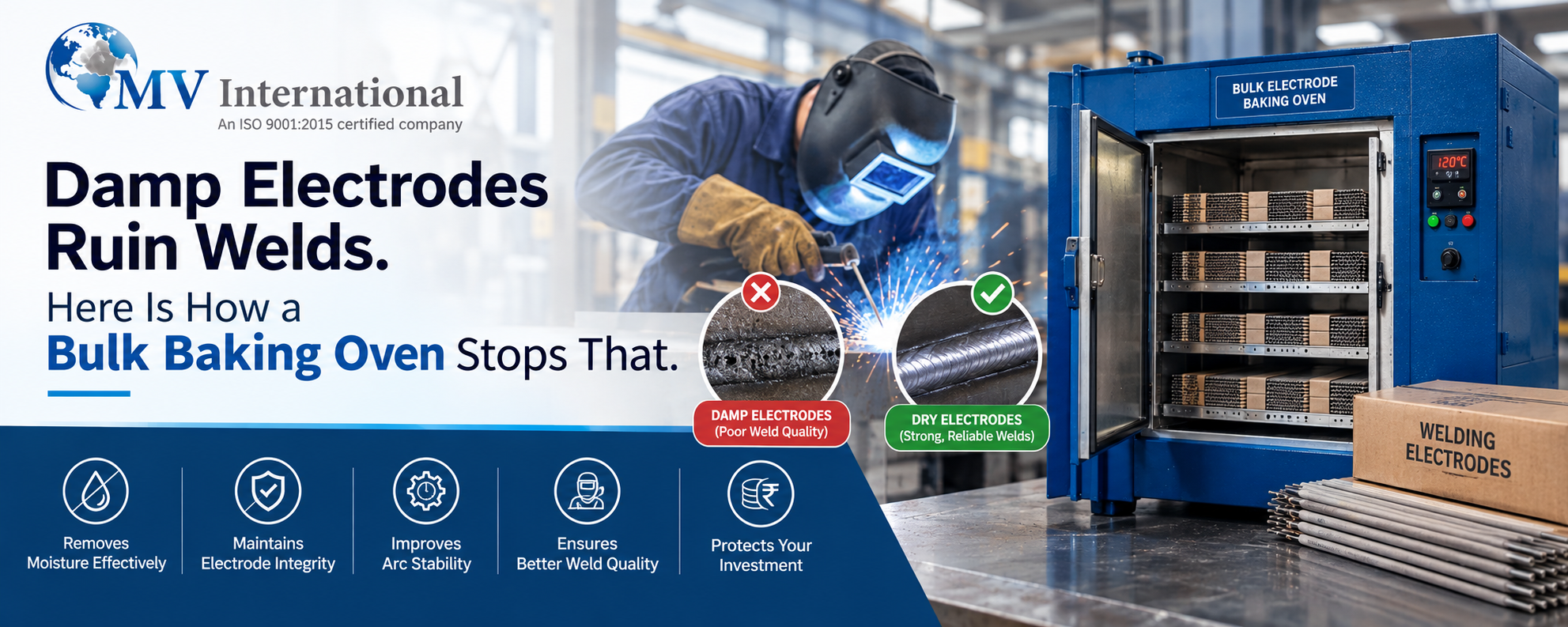
Welding electrodes pull moisture from the air within hours of leaving a sealed packet. That moisture leads to porosity, hydrogen-induced cracking and weak joints in structural and pressure work. A mother oven fixes this by rebaking electrodes in bulk and holding them at a set temperature until they reach the welding bay. MV International has designed and built this equipment in Bahadurgarh, Haryana since 1989, and that record sets it apart from newer Mother Oven Manufacturers who treat the product as a plain heated cabinet.
A mother oven bakes and stores welding electrodes in large batches, driving absorbed moisture out of the flux coating before the rods reach the welder. It serves as the central baking unit on site and feeds smaller portable quiver ovens at each workstation. Built from stainless steel, it holds a steady temperature for long stretches, which protects the coating and keeps weld quality consistent across every shift.
Its main jobs on a busy line:
MV International builds its mother oven with a capacity range of 25 kg to 500 kg and a temperature range of 50°C to 450°C, which covers low-hydrogen electrode baking and general fabrication. The input supply is 230 to 415 volts AC on three phases. Both thermostat and digital controller versions are available, so the control system matches your accuracy needs and your budget.
Key specifications to weigh up:
As experienced Mother Oven Manufacturers, the team sizes each unit to the volume of electrodes a plant consumes in a shift, rather than selling one fixed model to everyone.
A mother oven is a stationary, high-capacity baking unit, while a portable electrode oven is a small, transportable holding device carried to the weld point. The two work together. The mother oven does the heavy baking in bulk, and the portable oven or quiver keeps a welder’s daily supply warm at the joint. Using both protects electrode quality from the store room to the arc.
Where each fits:
Reliable Mother Oven Suppliers should prove build quality, not merely quote the lowest price. Ask about steel grade, heating element rating, insulation thickness and controller accuracy before you commit. MV International backs every unit with in-house manufacturing, spare parts through a settled distributor network and direct factory contact, which counts when a heating element or thermostat needs replacing years later.
Run through this checklist:
MV International works as one of the established Mother Oven Exporters from India, supplying welding and fabrication plants across more than 50 countries. Its ovens run on standard three-phase supply with stainless steel bodies that cope with transit and mixed site conditions. Export orders carry documentation support and freight-ready packing, so buyers in the Gulf, Africa and Southeast Asia receive equipment they can install without surprises.
Heavy fabrication, shipbuilding, pressure vessel work, pipeline construction and structural steel plants all rely on properly baked electrodes, since a single porous weld can fail an inspection or a service load. These sectors run continuous welding and cannot afford damp rods. A mother oven gives them a dependable central source of dry electrodes, feeding many welders from one controlled unit. That reliability is why repeat orders arrive from across the country and beyond, and it reflects a client base built over three decades of ISO-certified manufacturing.
Start by measuring your electrode consumption per shift, your electrode type and the control accuracy your code work demands, then match those figures to a capacity and a controller. Among Indian Mother Oven Suppliers, MV International lets you speak directly with the factory rather than a reseller, which shortens both sizing decisions and after-sales support. As long-standing Mother Oven Exporters, the firm can also arrange the paperwork and packing for overseas delivery. Send your electrode grade, daily volume and site voltage to +91 9718290000, and ask for a quote built around those numbers rather than a stock catalogue price.
Copyright © 2026 MV International. All Rights Reserved.