By MV International | 16 July 2026
Electric motors are essential components in industrial plants, manufacturing facilities, power stations, and commercial equipment. Their reliability depends heavily on the condition of the stator winding insulation, which can be seriously affected by moisture. During storage, transportation, flooding, or long periods of inactivity, moisture can penetrate the windings and reduce insulation resistance, increasing the risk of short circuits, insulation breakdown, arc flashes, and costly motor failure.
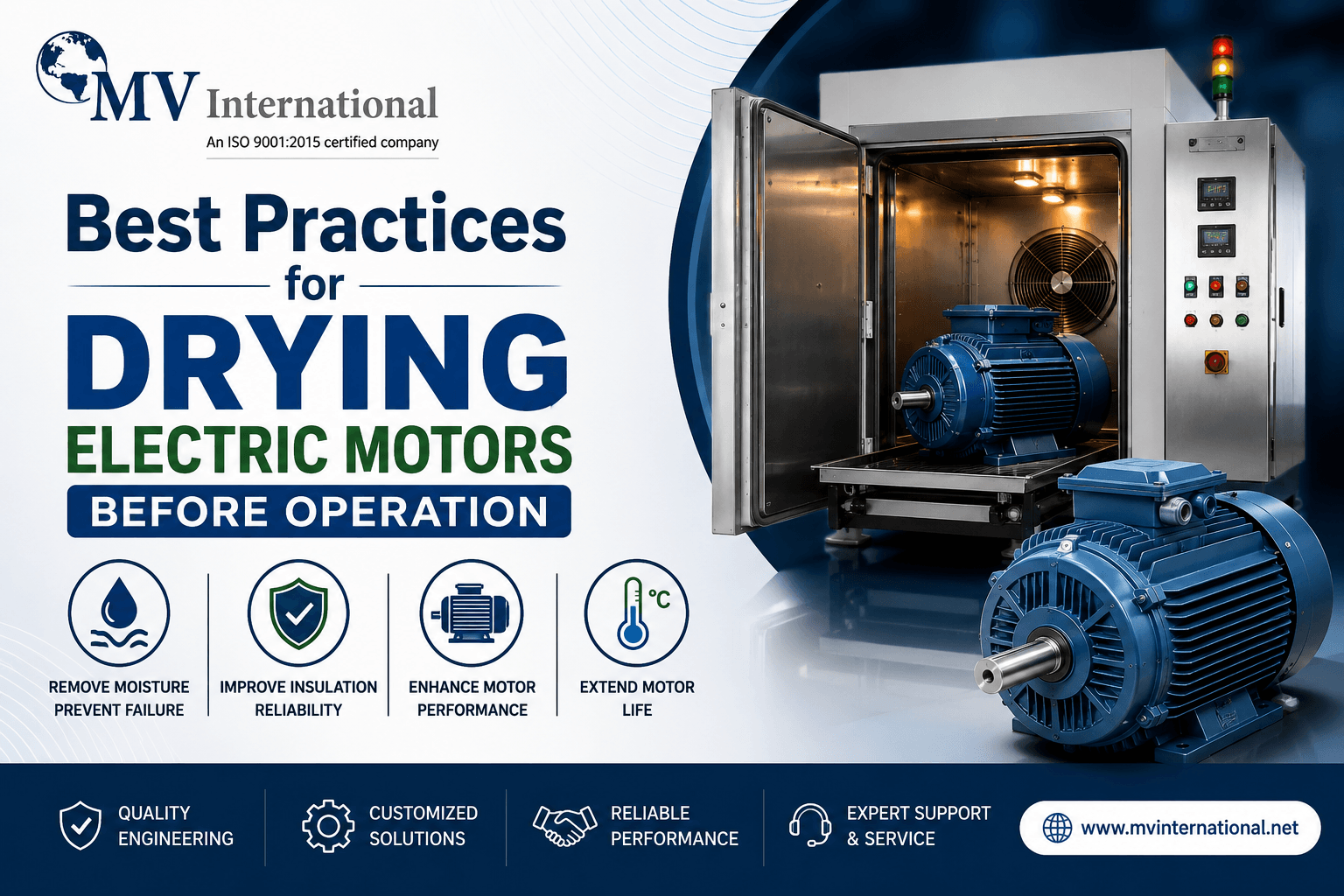
Proper drying of electric motors before returning them to service is a critical maintenance practice. By using the correct drying method, controlling the heating process, and continuously monitoring insulation resistance, maintenance teams can restore motor performance while protecting valuable equipment from permanent damage.
Before applying any heat, engineers must measure the baseline moisture level using a megohmmeter. This device applies a low DC voltage to calculate the Insulation Resistance (IR) and the Polarisation Index (PI). The Polarisation Index is the ratio of the 10-minute resistance reading to the 1-minute resistance reading. A PI value below 1.5 indicates severe moisture saturation and demands immediate intervention. Attempting to operate a motor below the acceptable threshold risks permanent electrical damage.
Table 1: Minimum Insulation Resistance (IR) Guidelines
| Motor Voltage Rating | Minimum Acceptable IR | Action Required if Below Threshold |
| Under 1000V | 5 Megohms | Immediate thermal drying required |
| 1000V to 2500V | 100 Megohms | Schedule drying during next maintenance |
| Over 2500V | 500 Megohms | Requires advanced thermal vacuum drying |
The chosen drying technique depends heavily on the motor size, the severity of moisture ingress, and whether the equipment can be safely removed from the factory floor.
Table 2: Comparison of Common Drying Techniques
| Drying Technique | Primary Advantage | Typical Application |
| Forced Air Oven | Highly controlled uniform heat | Standard industrial motors in workshops |
| Vacuum Chamber | Protects fragile insulation | High-voltage or highly saturated stators |
| Trickle Heating | Requires no heavy dismantling | Large fixed machinery on site |
A common error in motor maintenance is applying maximum heat immediately. If the external temperature rises too quickly, the outer layers of the winding dry and seal. This traps liquid water deep inside the inner coils. As the internal temperature eventually rises, the trapped water turns into pressurised steam. The rapid expansion of this trapped vapour cracks the insulation from the inside out.
To prevent this internal fracturing, thermal processing must follow a strict, phased ramp rate using precision thermostatic controls.
Table 3: Phased Heating Protocol for Stator Windings
| Heating Phase | Target Temperature | Objective |
| Initial Warming | 65°C to 75°C | Evaporate surface condensation safely |
| Deep Extraction | 85°C to 95°C | Draw out internal moisture slowly |
| Final Baking | 105°C to 115°C | Ensure total dryness without exceeding varnish limits |
Drying is not a timed process. It is entirely a condition-based process. Throughout the heating cycle, technicians must periodically halt the heat application and measure the insulation resistance. As the motor dries, the resistance value will steadily climb. The drying process is complete only when the megohmmeter readings stabilise at a highly acceptable level for several consecutive hours. Continuing to bake the motor after the resistance has flatlined wastes energy and risks making the insulation brittle.
Restoring an electric motor drying oven requires exact thermal management. Relying on makeshift heating solutions risks destroying the very equipment you intend to save. By utilising professional forced-air baking ovens from MV International, facilities gain the strict temperature regulation and airflow necessary to dry windings safely, extending the operational lifespan of critical industrial machinery.
Applying high voltage to wet windings causes the electrical current to bypass the intended circuits. This creates arcing, which instantly burns the internal insulation and requires a complete and costly rewind of the entire stator.
The duration varies significantly based on the motor size and the extent of water ingress. Small motors might achieve acceptable resistance levels in 12 hours, while massive industrial generators can require several days of continuous thermal processing to dry completely.
No. Standard commercial ovens lack the precision airflow controls and safety ventilation required to extract moisture safely. Industrial baking ovens designed by MV International feature specific exhaust mechanisms to remove humid air and prevent explosive vapour buildup from heating industrial varnishes.
Copyright © 2026 MV International. All Rights Reserved.