By MV International | 24 March 2026
Selecting thermal processing equipment requires a deep understanding of metallurgy, chemical curing, and continuous production dynamics. Every manufacturing floor operates with distinct thermal requirements that dictate the structural design of the heating machinery. A standard unit will never solve the complex thermal challenges present in advanced component manufacturing. When you evaluate the airflow patterns and thermal capacities of a commercial heating chamber, you directly influence the long-term operational success of your entire facility. Choosing the correct Industrial oven requires careful assessment of your daily production volumes and specific heat distribution requirements. Establishing these parameters early prevents costly operational disruptions later.
Before reviewing any technical specification sheets, you must define the exact physical transformations you expect your metal or composite parts to undergo. Different applications demand unique thermal environments. Baking finishes onto automotive parts requires different atmospheric conditions compared to drying moisture from pharmaceutical powders. Heat treatment alters the physical properties of metals, requiring precise, prolonged thermal exposure. Understanding the underlying chemistry of your process dictates the type of machinery you need. You must consult with technical experts to outline these fundamental heating requirements properly. Our engineering team at MV International frequently observes that facilities encounter production bottlenecks because their heating equipment does not align with their primary thermal processes. You must categorise your needs precisely.
The method by which hot air circulates within the heating chamber fundamentally changes the structural integrity of your finished product. If the air does not reach every surface of a complex component, the resulting uneven cure creates immediate quality control rejections. You must evaluate the geometry of your products to select the correct air distribution pattern for your manufacturing line.
| Airflow Pattern | Best Suited For | Operational Advantage |
|---|---|---|
| Horizontal Airflow | Trays and flat loaded shelves | Provides uniform heat across multiple solid tiers. |
| Vertical Airflow | Hanging parts and porous loads | Forces air up through the product for deep penetration. |
| Combination Airflow | Complex, multi-dimensional parts | Ensures total surface coverage for intricate geometries. |
The internal temperature of your heating equipment must remain completely stable from the top corner to the bottom floor. Temperature fluctuations cause severe structural defects, especially when curing high-grade resins or treating aviation-grade alloys. Maintaining a tight thermal tolerance prevents these expensive material failures. When you invest in a well-engineered Industrial oven, you acquire sophisticated programmable logic controllers that monitor these thermal zones constantly. These digital systems adjust the burner output within milliseconds.
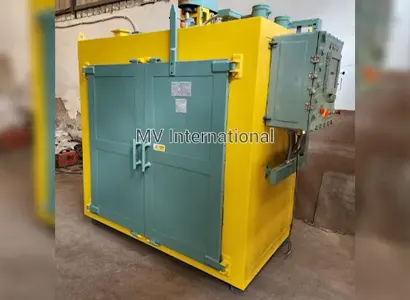
The physical chassis of your thermal processing unit faces constant expansion and contraction cycles daily. Substandard structural framing will warp under continuous high-temperature operations, leading to severe heat loss and increased energy consumption. High-density rock wool insulation packed between heavy-gauge steel walls retains the internal thermal energy effectively. Engineers at MV International construct thermal chambers using premium materials specifically chosen to endure harsh factory conditions for decades without structural degradation.
Safety protocols remain the paramount concern when operating heavy thermal equipment. Proper exhaust systems must vent volatile organic compounds safely away from the factory floor to prevent health hazards and combustion risks. Integrating explosion relief panels provides a necessary safeguard when processing highly flammable solvents. Selecting machinery that prioritises operator safety ensures continuous, uninterrupted production cycles. Operating a heavy-duty Industrial oven requires strict adherence to these safety standards to protect your workforce and your facility. Comprehensive training for your operational staff further guarantees that the machinery functions within its designated safety parameters at all times. Regular maintenance schedules prevent the dangerous accumulation of combustible residues inside the ductwork. Overlooking these critical safety maintenance routines often leads to catastrophic equipment failure and prolonged production downtime.
Evaluating your production requirements thoroughly protects your capital investment and enhances your daily operational output. You should document your spatial constraints, power availability, and ventilation capacities before speaking with engineering consultants. If you are reviewing your current thermal processing capabilities, assessing the custom-built systems developed by MV International offers a reliable, engineered approach to upgrading your manufacturing infrastructure. You must always secure equipment that aligns perfectly with your distinct material processing requirements.
Does the external casing of the heating unit become hot during operation?
Heavy thermal insulation ensures the exterior walls remain cool to the human touch. This design protects workers from accidental burns and prevents the surrounding factory environment from overheating.
How long does a standard curing cycle typically take?
The duration depends entirely on the thickness of the material and the specific chemical composition of the coating. Advanced digital controllers allow operators to set precise cycle times for different production batches.
Is it difficult to install a large thermal processing unit?
Installation requires professional rigging and proper electrical routing. Manufacturers usually construct these large units in modular sections, allowing for straightforward assembly directly on your factory floor.
Copyright © 2026 MV International. All Rights Reserved.