By MV International | 23 March 2026
Manufacturing often feels like a race against time where the smallest error in cleaning equipment leads to a massive halt in production. For decades, removing tough layers of paint, grease, or hardened resin from metal parts required intense manual labour or hazardous chemicals. However, the shift towards thermal stripping has changed the landscape for workshops. A burn off oven provides a controlled environment to thermally decompose organic coatings, turning them into ash. This process ensures that expensive jigs, fixtures, and hooks are restored to their original state without the structural damage often caused by mechanical scraping or harsh acid baths.
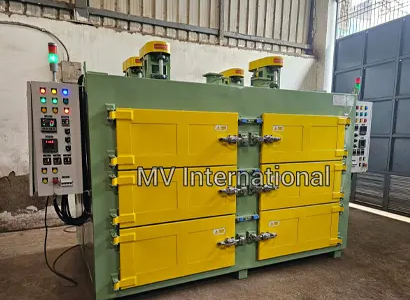
The move toward automation is not about replacing human intelligence but about supporting it. Older thermal processing units required constant monitoring of temperature gauges and manual adjustment of air intake. A modern burn off oven manufacturer now integrates PLC-based one touch systems to eliminate these complexities. With a single command, the machine manages the entire cycle, from the initial heating phase to the final cooling period. This technology uses sensors to monitor the internal atmosphere, ensuring that the temperature remains within a safe range to prevent the warping of metal parts. By automating the ramp-up and soak times, operators can focus on other high-value tasks while the machine handles the precision work.
When looking at the technical data of these machines, the focus is usually on efficiency and safety. Our engineering team at MV International focuses on building robust structures that handle heavy industrial loads. The internal chambers are lined with high-density ceramic fibre insulation to keep the heat inside and protect the outer shell.
| Feature | Standard Manual Oven | One Touch Control Oven |
|---|---|---|
| Control System | Manual Thermostats | Programmable Logic Controller |
| Safety Features | Basic Limit Switches | Water Sprays and Explosion Relief |
| Temperature Range | Fixed Heat Levels | Variable Multi-Stage Cycles |
| User Interface | Analogue Dials | Digital Touchscreen Interface |
| Maintenance | Frequent Calibration | Self-Diagnostic Alerts |
These units typically operate between four hundred and four hundred and eighty degrees Celsius. They feature secondary combustion chambers, also known as afterburners, which reach much higher temperatures to destroy smoke and volatile organic compounds before they exit the stack. This ensures the facility stays compliant with environmental regulations regarding emissions.
Sustainability is no longer a choice; it is a necessity for staying competitive. Using a burn off oven reduces the reliance on toxic stripping chemicals that are difficult to dispose of and harmful to the respiratory health of workers. The thermal process is a closed-loop solution where the only byproduct is a small amount of fine ash that is easy to brush away.
Choosing the right burn off oven manufacturer is a decision that impacts the reliability of your production line for the next twenty years. It is about finding a partner who understands the physics of heat distribution. MV International designs these systems to solve the specific problems of paint shops and motor rewinding facilities. When a motor stator needs its old resin removed, the heat must be uniform to avoid damaging the laminations. A well-built oven provides this uniformity, ensuring that the value of the component is preserved. The return on investment comes from the reduction in rejected parts and the speed at which tools return to the assembly line.
Choosing a reliable thermal solution allows your business to operate with a level of precision that manual methods cannot match. If you are looking to upgrade your facility with technology that prioritises safety and ease of use, exploring our range of custom-built thermal processing units is a practical step forward.
Does the high heat damage the metal jigs?
The system is designed to stay below the annealing temperature of steel. This means the metal parts do not lose their strength or change shape during the cleaning cycle.
How long does a typical cleaning cycle take?
Most cycles last between three and five hours depending on the thickness of the coating. The one touch system manages this time automatically based on the selected program.
What happens to the smoke generated during the process?
The afterburner chamber consumes the smoke at temperatures exceeding eight hundred degrees Celsius. This converts the smoke into invisible, odourless gases that meet environmental standards.
Is special training required to operate the touchscreen system?
The interface is designed for simplicity. A brief orientation is usually enough for any staff member to safely start and monitor a cycle.
Copyright © 2026 MV International. All Rights Reserved.