By MV International | 11 June 2026
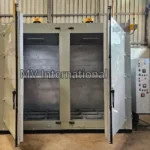
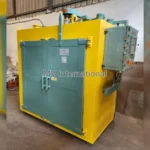
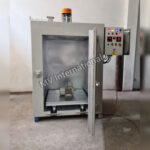
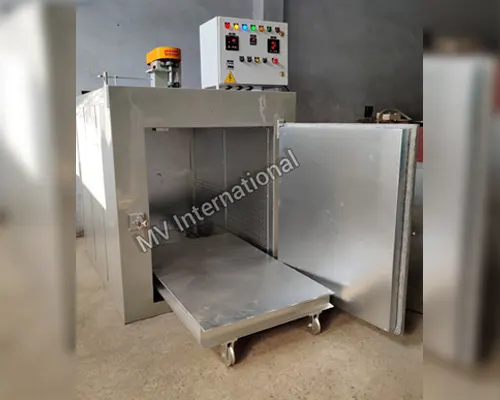
A varnish baking oven is the true backbone of heavy industrial electric motor repair and manufacturing processes across the globe. When an electric motor fails prematurely due to moisture or vibration, the root cause is almost always an incomplete insulation curing process. When your heavy industrial machinery shuts down unexpectedly because a vital winding has short-circuited, it causes immense problems. MV International designs industrial heating solutions that ensure your motor coils are perfectly insulated to handle harsh operating environments.
| Curing Stage | Temperature Range | Process Objective | Final Quality Benefit |
| Preheating | 100°C to 120°C | Removes hidden moisture | Prevents internal air pockets |
| Dipping / Coating | 40°C to 60°C | Applies liquid insulation | Full coverage of copper wire |
| Curing / Baking | 130°C to 160°C | Hardens resin chemically | High mechanical strength |
| Cooling | Ambient air | Stabilises the polymer | Ready for heavy assembly |
Electric motor windings consist of tightly wound copper coils that experience extreme electrical and mechanical stress during daily operations. Without a proper thermal processing system, the liquid protective resin applied to these coils will never achieve its optimum chemical bonding potential. A specialized varnish baking oven provides uniform forced air circulation that drives out dangerous volatile organic solvents from the deepest layers of the stator. This uniform heat distribution eliminates the risk of soft spots or wet resin pockets that can cause catastrophic electrical short circuits later. Our engineering team at MV International builds these thermal systems to ensure that every single section of your motor winding receives identical thermal treatment.
When copper wires rub against each other inside a running motor, their thin protective enamel coating wears away very quickly. A precise varnish baking oven transforms loose, vulnerable wire bundles into a completely solid, rigid mass that resists harmonic vibrations. This mechanical stabilization is absolutely vital for heavy industrial motors that operate continuously under high load conditions.
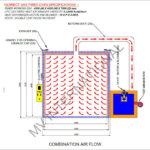
Moisture is the primary enemy of electrical insulation, often causing total system failure in humid processing plants. Standard heating methods often cure only the outermost surface of the resin, leaving hazardous moisture trapped deep inside the copper windings. A professional varnish baking oven uses advanced air flow paths to cure the insulation layer from the inside out. This thorough process creates a highly dense, non-porous barrier that blocks water molecules, chemical fumes, and airborne dust particles.
| Motor Feature | Without Precise Curing | With MV International Curing |
| Insulation Value | Low megohm readings | High stable megohm readings |
| Coil Movement | High risk of friction | Zero physical wire movement |
| Heat Dissipation | Poor due to air pockets | Excellent solid mass transfer |
| Equipment Lifespan | Short operational life | Extended heavy-duty lifecycle |
Air is an exceptionally poor conductor of heat, meaning air gaps inside motor windings will trap heat and raise temperatures. When a specialized varnish baking oven eliminates these miniature air pockets, the cured resin acts as an efficient thermal bridge. This improved thermal path allows internal heat to move quickly from the inner core to the outer motor frame. MV International thermal equipment ensures your motors run cooler, which directly protects the insulation system and extends operational life.
If you want to enhance your motor repair quality and eliminate premature winding failures, contact the engineering experts at MV International to discuss your specific thermal processing requirements.
The standard temperature generally ranges between 130°C and 160°C depending on the specific class of insulation resin used.
The entire thermal process typically requires 4 to 8 hours to ensure complete chemical cross-linking of the polymer.
Standard ovens lack the specialized forced air circulation required to safely remove volatile solvent vapours without causing explosions.
Yes, thorough baking removes moisture and solvent residues, which significantly increases insulation resistance values across all coils.
Calibration must be carried out at least once every 6 months to maintain absolute temperature uniformity inside the chamber.
Copyright © 2026 MV International. All Rights Reserved.