

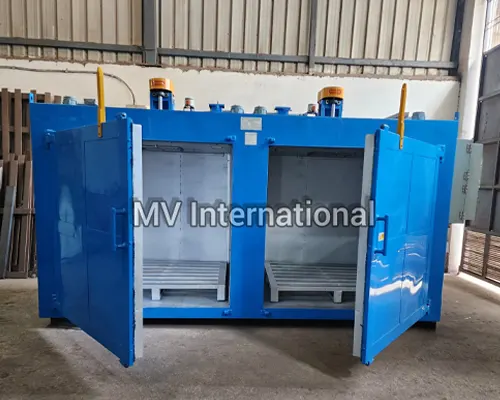
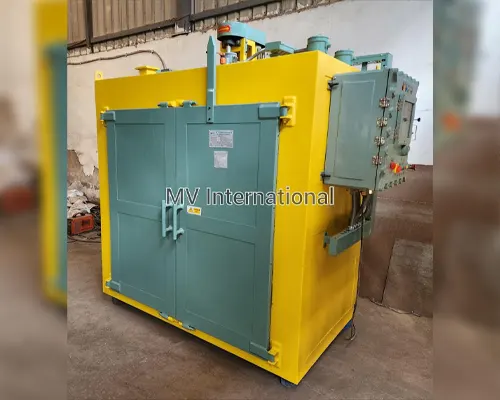
We are a drum warming oven manufacturer who provides the essential thermal solutions that keep industries flowing, quite literally. In sectors ranging from pharmaceuticals and food processing to chemicals and petrochemicals, handling temperature-sensitive materials stored in standard 200-liter drums or IBC totes is a daily challenge. As a specialized manufacturer, we design ovens that gently and evenly heat these containers to prevent freezing, reduce viscosity, and ensure that contents like honey, glucose, waxes, fats, and bitumen can be pumped or poured with ease.
We understand that localized heating can damage sensitive materials. Unlike band heaters that create intense hot spots, our drum warming ovens utilize a sophisticated forced air circulation system. This ensures that warm air is distributed uniformly around the entire surface of the drum, penetrating to the core of the material without burning or degrading it.
Our construction is built for the rugged industrial environment. We use heavy-duty Mild Steel or Stainless Steel (304/316) for the inner and outer chambers, ensuring resistance to corrosion and physical impact. To maximize energy efficiency, the double-walled structure is packed with high-density mineral wool insulation. This traps the heat inside, reducing your operating costs and keeping the external surface safe for your workforce.
Temperature precision is non-negotiable when dealing with chemicals or food products. Our drum warming ovens come equipped with digital PID temperature controllers that allow operators to set specific set-points, typically ranging from ambient to 150°C or higher depending on the application. This ensures that materials are brought to their optimal processing temperature without the risk of overheating.
Safety is paramount in our design philosophy. For industries operating in hazardous environments where flammable gases may be present, we offer flameproof models. These units feature explosion-proof heating elements, motors, and control panels, ensuring safe operation even in Zone 1 and Zone 2 areas. Additionally, our ovens include safety interlocks that automatically cut off power to the heaters and fans when the doors are opened, protecting operators from hot air blasts.
Material handling is often just one step in a larger production chain. In the electrical repair industry, for example, the consistency of insulating varnishes is critical. Before a motor stator is placed in a motor heating oven for pre-heating or burnout, the varnish must be at the correct viscosity to penetrate deep into the windings. Our drum warming ovens ensure that your varnish is perfectly fluid and ready for application.
Once the impregnation process is complete, the component typically moves to a varnish baking oven for the final curing stage. By maintaining the right temperature at every stage—from raw material storage to final curing—we help you achieve a flawless finish and superior electrical insulation.
Don’t let cold weather or viscous materials slow down your production. As a trusted drum warming oven manufacturer, MV International is ready to build a solution tailored to your capacity and temperature needs. Contact us today to discuss your requirements and keep your process moving efficiently.
A drum warming oven is an industrial heating system designed to gently and uniformly warm materials stored in drums or containers. It is commonly used to reduce the viscosity of thick or semi-solid materials, prevent freezing or solidification, and make products such as oils, waxes, resins, adhesives, honey, fats, and chemical compounds easier to pump, pour, mix, or process.
A drum warming oven is primarily designed for gentle and controlled heating to reduce viscosity, prevent freezing, or maintain material flowability. A drum heating oven is generally used for applications requiring higher or more intensive heating, including melting or processing materials at elevated temperatures. The right solution depends on the material type, required temperature, heating time, and production process.
Drum warming ovens can be used for various viscous, semi-solid, or temperature-sensitive materials, including oils, lubricants, waxes, resins, adhesives, bitumen, honey, glucose, fats, and chemical compounds. The required temperature and heating method should be selected according to the material’s properties and processing requirements.
A drum warming oven provides controlled and uniform heating around the container, helping to minimize localized hot spots that may occur with some external heating methods. This makes it suitable for materials that require gradual and consistent warming to improve flowability while reducing the risk of overheating or material degradation.
A drum warming oven uses a controlled heating system and forced-air circulation to distribute warm air evenly around drums or containers placed inside an insulated chamber. The controlled airflow gradually warms the material and helps reduce its viscosity, making it easier to pump, pour, transfer, mix, or process.
The operating temperature depends on the material and application requirements. Drum warming ovens can be designed for controlled low-to-moderate temperature applications, with the exact temperature range selected according to the product’s viscosity, melting point, freezing point, and heat sensitivity. The appropriate operating temperature should always be determined based on the material being processed.
Yes. A drum warming oven can help prevent temperature-sensitive materials from freezing, hardening, or becoming excessively viscous during storage and production. It is especially useful for materials that become difficult to pump, pour, or transfer when exposed to low temperatures.
Yes. Drum warming ovens can be designed to accommodate commonly used industrial drums, including 200-liter drums, depending on the required chamber dimensions and loading arrangement. The oven capacity can be customized according to the number and size of drums that need to be warmed in each batch.
Yes. Drum warming ovens and industrial warming chambers can be designed for IBC totes as well as standard drums, depending on the container dimensions, heating requirements, loading method, and production capacity. The IBC tote size and application details should be provided when specifying the equipment.
Flammable and hazardous materials require specially designed equipment and appropriate safety measures. For such applications, a suitable flameproof or explosion-proof configuration may be required depending on the material’s flash point and hazardous-area classification. The material safety information and application details should be shared with the manufacturer before selecting the oven.
Depending on the application, drum warming ovens can be designed with different heating methods, including electric heating, steam heating, thermic fluid heating, gas, or diesel-based systems. The ideal heating method depends on the required temperature, heating capacity, available utilities, operating cost, and specific process requirements.
Yes. Drum warming ovens can be equipped with digital temperature controllers or PID controllers to maintain the required temperature accurately. Advanced control systems can also support programmable heating cycles and monitoring features, helping ensure consistent and repeatable warming results.
Yes. Depending on the application, a drum warming oven can be equipped with automation systems such as PLC, HMI, PID temperature controllers, alarms, data logging, and SCADA integration. These features can help monitor the warming process, control temperature automatically, and maintain consistent operating conditions.
The right drum warming oven should be selected based on several factors, including the material type, required warming temperature, drum or IBC size, number of containers per batch, desired heating time, production capacity, available utilities, safety requirements, and available floor space. Providing these details to the manufacturer helps ensure the oven is correctly sized and configured for the application.
Before purchasing a drum warming oven, consider the material being warmed, required temperature range, drum or container dimensions, heating capacity, temperature uniformity, heating method, safety features, automation options, construction material, energy efficiency, customization capabilities, and after-sales support. For specialized or hazardous applications, it is also important to confirm that the manufacturer can provide the required safety and process specifications.
Copyright © 2026 MV International. All Rights Reserved.
