
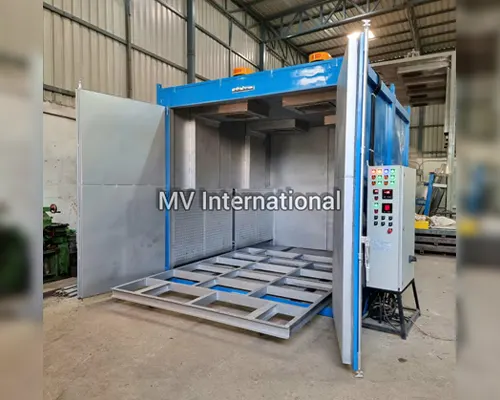
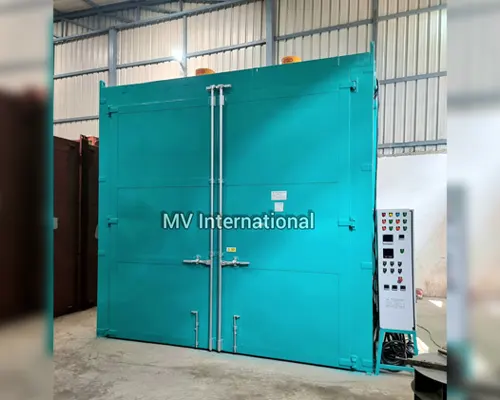
A reputed armature drying oven manufacturer is synonymous with precision, durability, and superior engineering in the heating industry. For years, MV International has specialized in designing high-performance ovens that cater to the rigorous demands of motor manufacturing and repair. An armature drying oven is a critical piece of equipment used to remove moisture from armatures, stators, and coils before they undergo further processing. By ensuring that these components are completely moisture-free, our ovens play a vital role in preventing electrical failures and extending the lifespan of your heavy-duty machinery.
As a premier armature drying oven manufacturer, we understand that uniform heating is the key to quality results. Our ovens are engineered with advanced airflow systems—available in vertical, horizontal, or combination flow—to ensure that every inch of the chamber receives consistent heat. This eliminates cold spots and ensures that moisture is effectively evaporated from deep within the windings of the armature.
Our ovens are built to last, featuring robust construction using high-grade Mild Steel or Stainless Steel (304/316). To minimize heat loss and maximize energy efficiency, we utilize premium insulation materials like ceramic or mineral wool. This not only reduces operational costs but also ensures the outer body remains safe to touch. Whether you require a standard model or a customized solution with specific tray sizes and temperature profiles, we deliver equipment that fits your production line perfectly.
Modern industrial processes require more than just heat; they require control. Our armature drying ovens come equipped with state-of-the-art digital temperature controllers and timers. Operators can easily set precise temperature ranges, typically from ambient up to 250°C or higher depending on the requirement, ensuring the safety of sensitive insulation materials.
Safety is a top priority in our design philosophy. Our units feature door interlocking systems that automatically switch off the heating elements and blowers when the door is opened, protecting operators from hot blasts of air. Additionally, we integrate automatic forced exhaust systems to efficiently expel moisture-laden air and introduce fresh air, accelerating the drying cycle significantly.
While drying is a crucial first step, the longevity of an electric motor often depends on the subsequent treatment of its windings. After the initial drying phase, components typically move to a coating stage. To support this, we also offer the high-performance Varnish Baking Oven, which is essential for curing the varnish applied to armatures and stators. This ensures a hard, durable finish that resists chemical and environmental damage.
Furthermore, for industries handling volatile substances or operating in hazardous zones, safety cannot be compromised. Beyond standard drying solutions, we manufacture specialized equipment like the Flameproof Drum Heating Oven. These units are designed to safely heat and lower the viscosity of materials stored in drums without the risk of ignition, making them ideal for chemical and petrochemical applications.
Choosing the right armature drying oven manufacturer can dramatically improve your production throughput and product quality. At MV International, we are committed to delivering technology that drives efficiency. Contact us today to discuss your specific heating requirements and discover how our world-class ovens can enhance your operational capabilities.
An armature drying oven is an industrial heating system designed to remove moisture, solvents, and other volatile substances from electric motor armatures and related electrical components. It is commonly used in motor manufacturing, rewinding, repair, and maintenance processes to improve insulation performance and prepare armatures for further processing.
An armature drying oven uses controlled heating and forced-air circulation to distribute heat evenly around the armature. Heated air passes through and around the components, helping moisture and solvents evaporate gradually. The controlled temperature and airflow help achieve uniform drying without damaging insulation or electrical components.
During motor repair and rewinding, armatures may absorb moisture during cleaning or other processes. Controlled drying helps remove this moisture and improves insulation resistance before testing or reassembly. A properly dried armature can help support reliable motor performance and reduce the risk of insulation-related problems.
Armature drying ovens are primarily used for electric motor armatures, rotor assemblies, windings, coils, and other electrical components that require controlled drying or heating. The oven can be designed according to the dimensions, weight, and thermal requirements of the components being processed.
The required drying temperature depends on the insulation system, winding materials, varnish or resin, armature size, and specific process requirements. The oven should be operated according to the recommended temperature and curing cycle of the insulation or varnish manufacturer to prevent damage to electrical components.
Forced-air circulation helps distribute heat evenly around the armature and removes moisture from the component more effectively. Proper airflow reduces hot spots and cold zones, helping ensure consistent drying throughout the armature, including areas that may be difficult to dry using static heating alone.
Yes. When designed for the required process temperature and airflow conditions, an armature drying oven can be used for curing varnish and insulating resins applied to armatures, windings, and other electrical components. The curing cycle should be selected according to the varnish manufacturer’s specifications.
The drying time depends on factors such as armature size, moisture content, winding density, insulation materials, operating temperature, and airflow. Smaller components may require shorter cycles, while large industrial armatures may need longer heating and drying periods. The correct cycle should be established based on the specific application.
Yes. Armature drying ovens can be equipped with digital or PID temperature controllers to maintain accurate and stable temperatures. Programmable temperature profiles, timers, alarms, and temperature recording systems can also be incorporated for applications requiring repeatable drying and curing cycles.
Yes. The oven can be customized according to armature dimensions, weight, batch capacity, production requirements, and available factory space. Chamber dimensions, heating capacity, airflow direction, door configuration, loading arrangements, shelves, and control systems can be designed according to specific process requirements.
Depending on the application and available utilities, armature drying ovens can be designed with electric, gas, diesel, steam, or thermic oil heating systems. The most suitable heating method depends on the required temperature, oven capacity, production volume, energy availability, and operating costs.
Depending on the oven configuration, safety features can include over-temperature protection, door interlocking systems, emergency shutoff controls, audible and visual alarms, temperature monitoring, and exhaust systems. Additional safety features can be provided based on the materials being processed and the specific application.
Yes. For industrial production environments, armature drying ovens can be integrated with PLC and HMI systems for automated process control, temperature monitoring, fault indication, and operator control. SCADA integration can also be provided for centralized monitoring, process management, and data recording.
An armature drying oven is specifically designed to accommodate armatures and rotor assemblies, while a motor winding drying oven is generally focused on drying motor windings and coils. Both systems use controlled heating and airflow, but the chamber design, loading arrangement, airflow pattern, and capacity can be optimized for the specific components being processed.
The right armature drying oven should be selected based on armature dimensions, weight, material, insulation system, moisture content, required drying temperature, drying cycle time, batch size, production capacity, airflow requirements, heating method, automation needs, and available factory space. Providing complete process details to the manufacturer helps ensure the oven is designed for consistent and reliable drying performance.
| Size of the working chamber | As per client requirement. |
| Material of construction | Mild Steel, Stainless Steel 304 / 316 or any. |
| Temperature Range | Ambient to 1500C / 2500C / 4000C / 5000C. |
| Air circulation | Vertical, Horizontal or Combination. High Volume and high Velocity Airflow provides twice the air changes compare to ordinary Industrial Ovens. |
| Timer | Digital Pre-Settable with range up to 0 to 999 Minutes / Seconds |
| Paint | Enamel Paint / Epoxy Coating / Powder Coated. |
| Power supply | 230 Volts Single Phase 50Hz / 60Hz 415 Volts 3 Phase 50Hz / 60Hz |
| Heating Elements | Low wattage Incoloy sheathed heating elements / SS Tubular |
| Insulation | Ceramic Wool / Mineral Wool |
| Door Gasket | Fibre Glass Rope (High Temp) / Silicon Gasket. |
| Heavy Duty Shelves / Trays | Made out of angles with wire knitted mesh or perforated sheet suitable for oven internal size will be provided along with the oven. |
| Exhaust Manual or Automatic | Automatic forced exhaust system with fresh air inlet. Manually adjustable damper with fresh air inlet. |
| Heating Media | Electric / Gas / Diesel / Steam / Thermic OIL etc. |
| Temperature Control | PID with or without Profile Setting (Temp Up and Down) can be provided with SSR/ SCR for high accuracy. The programming of PID can vary from 4 to 50 programmes. |
| Temperature Recorder | Microprocessor chip-based paper less, Multi-Stage Temp. Indicator cum Recorder. |
| PLC With HMI | PLC can be provided for automation and integration of whole system, data feeding, process display, and fault indication can be seen in HMI. |
| SCADA System | High quality integration and controlling system from one point can be done with SCADA. |
| Door | A. Door interlocking system will switch off the blower and the heating system if the oven doors are open
B. Doors on both ends |
| Fumes Outlet | Forced exhaust blower |
| Windows and lights | A. Viewing window B. Interior lights and Access ports for calibration C. Oven on switch- Illuminated D. Heat on switch- Illuminated |
| Timer and Alarm | A. 24/7 timer B. Audible/visual alarm indicators |
Copyright © 2026 MV International. All Rights Reserved.
