

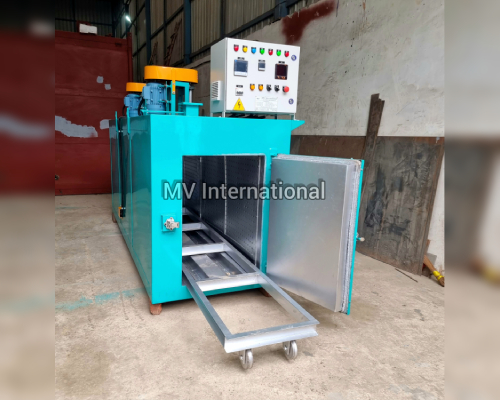
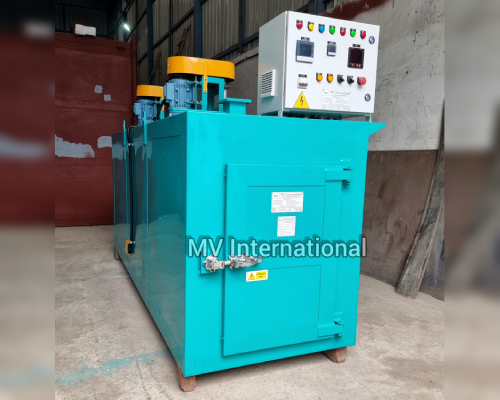
A stator drying oven is used in industries all over. In electric motor production, moisture control decides service life. A single stator can hold several grams of trapped moisture after winding and varnish application. At temperatures between 120°C and 160°C, controlled heat removes this moisture within fixed cycles that often run under eight hours. Plants track this because insulation failure rates drop when drying is stable and repeatable. The stator drying oven sits quietly at the center of that discipline, handling heat, airflow, and time with measured accuracy. MV International builds systems around these known numbers because production data always speaks first.
A stator drying oven is used to remove moisture from motor and generator stators after winding, washing, or varnish impregnation. Moisture left inside copper windings or insulation layers can shorten electrical life and affect performance testing.
These ovens apply uniform heat and managed airflow so each stator reaches the required temperature without surface damage or uneven curing. In industrial settings, the oven becomes part of a defined process step rather than a standalone machine.
A stator drying oven uses guided airflow, controlled ramp rates, and insulated chambers to keep temperature deviation within narrow limits across the load.
Insulation systems depend on correct drying before final curing. When heat rises too fast, varnish skins over. When airflow is weak, moisture remains trapped. A stator drying oven avoids both conditions through steady temperature rise and consistent circulation.
This approach supports predictable dielectric strength and stable resistance readings during testing. Facilities using defined drying cycles report fewer rework cases tied to insulation defects.
Selection usually depends on production volume, stator size range, and floor layout. Technical review often focuses on control accuracy and service access.
Key factors commonly reviewed include:
Only this stage determines whether the oven fits daily production without adjustment delays.
Yes. Most industrial plants require adaptation rather than standard sizing. A stator drying oven can be designed as batch or continuous, front-loaded or walk-in, depending on handling flow. Control systems can also align with existing plant monitoring tools.
MV International approaches this through layout study and process review, ensuring the oven fits the work pattern instead of reshaping it.
If your team wants to discuss drying requirements in practical terms, MV International welcomes a direct technical conversation. The right oven choice usually becomes clear once real production conditions are placed on the table.
Why is a stator drying oven needed for electric motor insulation drying?
Drying removes moisture, stabilizes varnish curing, reduces dielectric failure risk, and supports consistent electrical performance across stator windings during operation.
What temperature range is standard for an industrial stator drying oven?
Typical stator drying oven temperatures range from 110°C to 180°C, depending on insulation class, airflow design, and process time requirements.
Should I choose a batch or continuous stator drying oven system?
Batch ovens suit varied stator sizes, while continuous systems fit high volume lines with fixed dimensions and repeatable cycles daily.
How does energy consumption vary in a stator drying oven process?
Energy use depends on insulation load, moisture content, airflow balance, and insulation thickness across each stator core during production cycles.
Can a stator drying oven be customized for motor manufacturing plants?
Yes, customization allows tray design, loading height, controls integration, and safety features aligned to plant workflow and compliance requirements standards.
| Size of the working chamber | As per client requirement. |
| Material of construction | Mild Steel, Stainless Steel 304 / 316 or any. |
| Temperature Range | Ambient to 1500C / 2500C / 4000C / 5000C. |
| Air circulation | Vertical, Horizontal or Combination. High Volume and high Velocity Airflow provides twice the air changes compare to ordinary Industrial Ovens. |
| Timer | Digital Pre-Settable with range up to 0 to 999 Minutes / Seconds |
| Paint | Enamel Paint / Epoxy Coating / Powder Coated. |
| Power supply | 230 Volts Single Phase 50Hz / 60Hz 415 Volts 3 Phase 50Hz / 60Hz |
| Heating Elements | Low wattage Incoloy sheathed heating elements / SS Tubular |
| Insulation | Ceramic Wool / Mineral Wool |
| Door Gasket | Fibre Glass Rope (High Temp) / Silicon Gasket. |
| Heavy Duty Shelves / Trays | Made out of angles with wire knitted mesh or perforated sheet suitable for oven internal size will be provided along with the oven. |
| Exhaust Manual or Automatic | Automatic forced exhaust system with fresh air inlet. Manually adjustable damper with fresh air inlet. |
| Heating Media | Electric / Gas / Diesel / Steam / Thermic OIL etc. |
| Temperature Control | PID with or without Profile Setting (Temp Up and Down) can be provided with SSR/ SCR for high accuracy. The programming of PID can vary from 4 to 50 programmes. |
| Temperature Recorder | Microprocessor chip-based paper less, Multi-Stage Temp. Indicator cum Recorder. |
| PLC With HMI | PLC can be provided for automation and integration of whole system, data feeding, process display, and fault indication can be seen in HMI. |
| SCADA System | High quality integration and controlling system from one point can be done with SCADA. |
| Door | A. Door interlocking system will switch off the blower and the heating system if the oven doors are open
B. Doors on both ends |
| Fumes Outlet | Forced exhaust blower |
| Windows and lights | A. Viewing window B. Interior lights and Access ports for calibration C. Oven on switch- Illuminated D. Heat on switch- Illuminated |
| Timer and Alarm | A. 24/7 timer B. Audible/visual alarm indicators |
Copyright © 2026 MV International. All Rights Reserved.
