

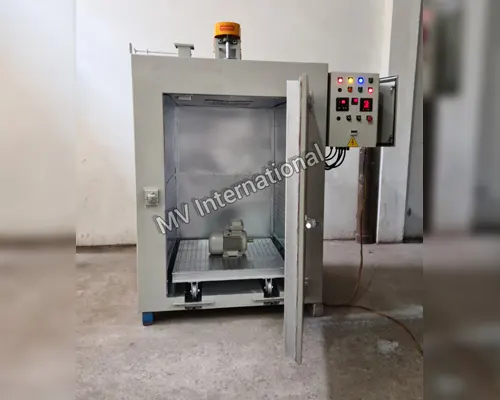
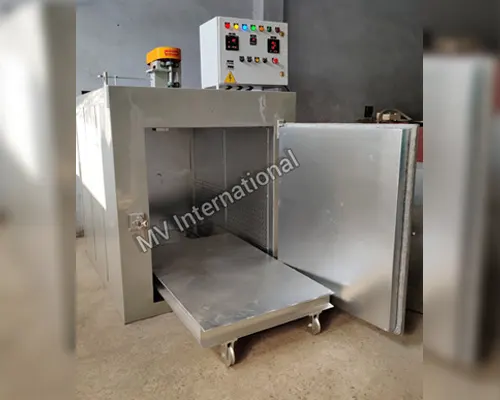
MV International is a varnish baking oven manufacturer and a distinguished leader in the industrial heating sector, specifically catering to the intricate needs of the electrical manufacturing and repair industries. The process of varnish baking—often referred to as curing—is a critical step in the production and maintenance of electric motors, transformers, and coils. By applying heat to impregnated windings, our ovens ensure that the varnish solidifies into a hard, moisture-resistant, and mechanically strong insulation layer. As a dedicated manufacturer, we design equipment that guarantees this curing process is executed with absolute precision, preventing failures and extending the operational life of your electrical machinery.
Choosing the right varnish baking oven manufacturer is essential for ensuring product quality and safety. Varnish curing involves more than just raising the temperature; it requires a controlled environment where solvents can evaporate safely without causing defects in the coating. Our ovens are engineered with high-velocity forced air circulation systems (using vertical or cross-flow patterns) to maintain uniform temperatures throughout the chamber. This eliminates “cold spots” that result in uncured varnish and “hot spots” that can degrade the insulation, ensuring a consistent finish on every stator or armature.
Our construction standards are second to none. We utilize double-walled mild steel or stainless steel casings filled with high-density mineral wool insulation. This design minimizes heat loss, ensuring that the oven operates efficiently and remains cool to the touch on the outside, which is crucial for operator safety in a busy workshop environment.
Dealing with varnish implies dealing with volatile organic compounds (VOCs) and solvents that can be flammable during the evaporation phase. Safety is, therefore, a non-negotiable aspect of our design. Our varnish baking ovens are equipped with explosion-relief panels and automatic exhaust systems. These systems actively purge solvent vapors from the chamber, replacing them with fresh air to keep the concentration below explosive limits.
Precision is managed through state-of-the-art digital PID controllers, allowing operators to set exact ramp-up and soak times. Whether you require a standard curing cycle at 150°C or a high-temperature bake for specialized resins, our controls ensure repeatability and accuracy.
In many industrial setups, the handling of varnish begins long before the baking stage. The raw varnish or resin is often stored in drums that may require heating to reduce viscosity for proper application. For facilities handling these volatile substances in storage, we recommend our specialized flameproof drum heating oven. This equipment ensures that your raw materials are prepped safely in hazardous zones without the risk of ignition, serving as the perfect precursor to the curing process.
At MV International, we understand that every production line is unique. We offer a versatile range of sizes, from small batch ovens to large walk-in, truck-in designs. If you are looking to upgrade your current setup or install a new varnish baking oven, our engineering team is ready to assist you.
Contact us today to discuss your technical specifications and discover how our thermal engineering expertise can improve your insulation quality and production throughput. We also supply other industrial ovens like barrel heating ovens and more!
A varnish baking oven is an industrial heating system used to cure or bake varnish and insulating resins applied to electrical components such as motor windings, stators, armatures, coils, and transformers. Controlled heating solidifies the varnish into a durable insulation layer that helps protect electrical components from moisture, mechanical stress, and environmental conditions.
A varnish baking oven uses controlled heating and forced-air circulation to evenly distribute heat throughout the chamber. Electrical components coated or impregnated with varnish are heated according to a defined curing cycle. The controlled temperature allows solvents and moisture to evaporate while the varnish cures and forms a strong, stable insulating layer.
A varnish baking oven helps ensure that insulating varnish applied to motor windings cures uniformly. Proper curing strengthens the insulation, reduces moisture penetration, helps secure winding wires, and improves the mechanical and electrical reliability of motors and coils.
Varnish baking ovens are commonly used for curing varnish on electric motor windings, stators, armatures, coils, transformers, and other electrical components that require thermal curing of insulating varnishes or resins.
The required curing temperature depends on the type of varnish, resin, insulation system, and manufacturer’s recommended curing cycle. MV International ovens can be designed with temperature ranges from ambient to 150°C, 250°C, 400°C, or 500°C, depending on the application. The actual curing temperature should always be selected according to the varnish manufacturer’s technical specifications.
Uniform airflow helps maintain consistent temperatures throughout the oven chamber and around the components being cured. Vertical, horizontal, or combination airflow patterns can help reduce cold spots and hot spots, supporting more consistent varnish curing and reducing the risk of uneven insulation quality.
During varnish curing, solvents and volatile organic compounds (VOCs) may be released. A properly designed varnish baking oven uses controlled exhaust and fresh-air circulation to remove vapors from the chamber. Automatic exhaust systems and appropriate ventilation help maintain safer operating conditions and support the curing process.
Varnish and solvent vapors can create flammable or hazardous conditions during curing, so appropriate safety engineering is essential. Depending on the material and process, the oven can be designed with features such as exhaust systems, explosion-relief panels, safety interlocks, and other suitable safety provisions. The varnish’s flash point, solvent composition, and process conditions should be provided to the manufacturer before equipment selection.
Yes. Varnish baking ovens can be equipped with digital PID temperature controllers for accurate temperature management. Optional programmable temperature profiles can allow controlled ramp-up, soaking, and curing cycles, helping achieve repeatable results for different varnish and resin systems.
Yes. Depending on the production requirements, the oven can be integrated with PLC and HMI systems for process automation, data display, fault indication, and control. SCADA integration can also be provided for centralized monitoring and control, while temperature recorders can support process documentation and traceability.
Depending on the application and available utilities, varnish baking ovens can be designed with electric, gas, diesel, steam, or thermic oil heating systems. The appropriate heating method depends on the required temperature, production capacity, energy availability, operating cost, and process requirements.
Yes. Varnish baking ovens can be customized according to the dimensions and weight of the components being processed. Chamber size, airflow direction, door configuration, heating capacity, shelving, loading arrangements, and control systems can be designed according to specific production requirements. MV International offers solutions ranging from smaller batch ovens to large walk-in and truck-in configurations.
Depending on the configuration, safety features can include automatic exhaust systems, explosion-relief panels, door interlocking systems, over-temperature protection, audible and visual alarms, and controlled fresh-air intake. Door interlocks can be designed to switch off heating and blower systems when the oven doors are opened.
Both ovens are used in electrical manufacturing and motor repair applications, but their use depends on the specific process and component requirements. A varnish baking oven is primarily focused on curing varnish or insulating resin after impregnation or coating, while a motor winding baking oven may be used more broadly for drying and baking motor windings and removing moisture or solvents. The appropriate oven should be selected according to the material, component, and required thermal process.
The right varnish baking oven should be selected based on the type of varnish or resin, curing temperature, curing time, component dimensions, batch size, required production capacity, airflow pattern, solvent and VOC characteristics, exhaust requirements, heating method, safety classification, and available factory space. Providing complete process details to the manufacturer helps ensure the oven is correctly designed for reliable and repeatable curing.
| Size of the working chamber | As per client requirement. |
| Material of construction | Mild Steel, Stainless Steel 304 / 316 or any. |
| Temperature Range | Ambient to 1500C / 2500C / 4000C / 5000C. |
| Air circulation | Vertical, Horizontal or Combination. High Volume and high Velocity Airflow provides twice the air changes compare to ordinary Industrial Ovens. |
| Timer | Digital Pre-Settable with range up to 0 to 999 Minutes / Seconds |
| Paint | Enamel Paint / Epoxy Coating / Powder Coated. |
| Power supply | 230 Volts Single Phase 50Hz / 60Hz 415 Volts 3 Phase 50Hz / 60Hz |
| Heating Elements | Low wattage Incoloy sheathed heating elements / SS Tubular |
| Insulation | Ceramic Wool / Mineral Wool |
| Door Gasket | Fibre Glass Rope (High Temp) / Silicon Gasket. |
| Heavy Duty Shelves / Trays | Made out of angles with wire knitted mesh or perforated sheet suitable for oven internal size will be provided along with the oven. |
| Exhaust Manual or Automatic | Automatic forced exhaust system with fresh air inlet. Manually adjustable damper with fresh air inlet. |
| Heating Media | Electric / Gas / Diesel / Steam / Thermic OIL etc. |
| Temperature Control | PID with or without Profile Setting (Temp Up and Down) can be provided with SSR/ SCR for high accuracy. The programming of PID can vary from 4 to 50 programmes. |
| Temperature Recorder | Microprocessor chip-based paper less, Multi-Stage Temp. Indicator cum Recorder. |
| PLC With HMI | PLC can be provided for automation and integration of whole system, data feeding, process display, and fault indication can be seen in HMI. |
| SCADA System | High quality integration and controlling system from one point can be done with SCADA. |
| Door | A. Door interlocking system will switch off the blower and the heating system if the oven doors are open
B. Doors on both ends |
| Fumes Outlet | Forced exhaust blower |
| Windows and lights | A. Viewing window B. Interior lights and Access ports for calibration C. Oven on switch- Illuminated D. Heat on switch- Illuminated |
| Timer and Alarm | A. 24/7 timer B. Audible/visual alarm indicators |
Copyright © 2026 MV International. All Rights Reserved.
